William Shakespeare: The Man Nobody Really Knows
William Shakespeare: The Man Nobody Really Knows
Literary Biography · Renaissance England
He wrote thirty-seven plays, 154 sonnets, and some of the greatest poetry in the English language. Then he disappeared back into history, leaving almost nothing behind.
June 2026 · 8 min read
Birth | Lost years | The Globe | The works | Critics | Mystery
Birth & background — 1564, Stratford-upon-Avon
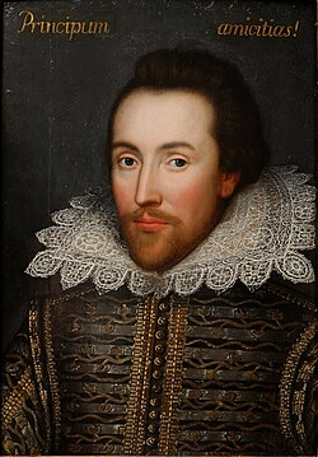 |
The Cobbe portrait of Shakespeare
|
Born on England’s most patriotic date — probably
He was baptised on 26 April 1564 in Stratford-upon-Avon — a market town in Warwickshire that was, even then, pleasantly unremarkable. His birth date is typically given as April 23rd, partly because baptism records show three days later, and partly because April 23rd is St. George’s Day, the feast of England’s patron saint. It felt poetically right to assign England’s greatest writer to England’s most patriotic date. This small piece of possible mythologising is entirely fitting for a man whose biography is full of it.
His father, John Shakespeare, was a glover who rose to become Stratford’s bailiff — essentially its mayor. His mother, Mary Arden, brought land and minor-gentry status to the marriage. The household was prosperous enough to send young William to the King’s New School, where he would have spent long days memorising Latin, studying rhetoric, and reading Ovid — whose Metamorphoses would haunt his imagination for the rest of his life.
“He was not of an age, but for all time.”
— Ben Jonson, preface to the First Folio, 1623
The lost years: 1585–1592
 |
|
AnneHathaway CUL Page4DetailB
|
He married at eighteen, had three children — then vanished
At eighteen, Shakespeare married Anne Hathaway, who was twenty-six and — here is the fact that has fuelled speculation for four centuries — already three months pregnant. Six months later their daughter Susanna was born. Less than two years after that, twins: Hamnet and Judith. And then, in the historical record, William Shakespeare simply disappears.
The years between 1585 and 1592 are known as the “lost years.” He is not in Stratford, not in any court record, not in any surviving letter or document. Theories range from the plausible (working as a country schoolmaster) to the romantic (travelling Italy, which might explain his detailed knowledge of Italian geography) to the controversial (working as a spy, linked to the government’s surveillance of Catholic households).
He resurfaces in London in 1592 — already established enough that a rival playwright, Robert Greene, attacks him in print as “an upstart crow, beautified with our feathers.” The insult is revealing: Greene was threatened. People who are threatened by you are often more honest about your talent than those who merely praise you.
“There is an upstart crow, beautified with our feathers, that supposes he is as well able to bombast out a blank verse as the best of you.”
— Robert Greene, 1592 (the first documented reference to Shakespeare as a playwright)
The Globe — London, 1599
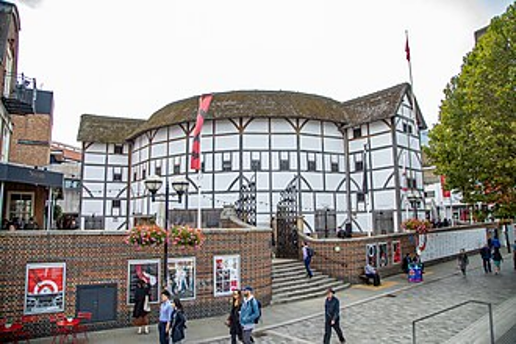 |
| Globe Theatre South Bank |
They dismantled a theatre in the middle of winter and carried it across the river
By the early 1590s, Shakespeare had joined the Lord Chamberlain’s Men — the acting company that would become the dominant theatrical force in Elizabethan London. Crucially, he was not merely a writer for hire. He was a shareholder. He owned a piece of the company, and later a piece of the Globe Theatre itself, built in 1599 on the south bank of the Thames.
The Globe was constructed from the timber of a demolished playhouse called The Theatre — which the company had quite literally dismantled beam by beam and carried across the frozen Thames in the dead of winter, in defiance of their landlord’s attempts to claim it. It was an act of spectacular audacity. Shakespeare owned roughly a 12.5% stake in the result.
The Globe seated approximately three thousand people. Groundlings stood in the yard for a penny; wealthier patrons sat in the galleries. Shakespeare wrote for all of them simultaneously — which is why his plays contain both the most sublime poetry in the English language and jokes about flatulence. He understood, instinctively, that art and entertainment are not opposites.
“All the world’s a stage, and all the men and women merely players.”
— As You Like It, Act II
The works — 37 plays · 154 sonnets
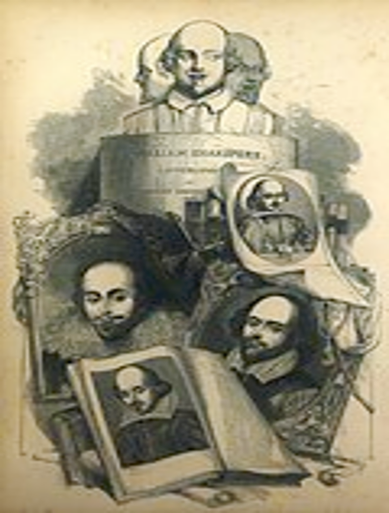 |
| Frontispiece to The Works of William Shakspere |
Two plays a year, for twenty-five years — and none of it feels rushed
The scale of what he produced is staggering: thirty-seven plays, 154 sonnets, several longer poems — most of it in roughly twenty-five years of professional writing. He often produced two new plays a year while simultaneously revising older ones, performing, and managing company business.
The early histories established him as the chronicler of English power. The romantic comedies of the mid-1590s — A Midsummer Night’s Dream, Twelfth Night, Much Ado About Nothing — gave audiences delight and the unsettling suggestion that identity might be far more fluid than anyone had supposed. Then the great tragedies arrived: Hamlet, Othello, King Lear, Macbeth. These are works of such psychological depth that four centuries of performance and scholarship have not exhausted them.
And then the sonnets — 154 of them, addressed to a beautiful young man and a dark-complexioned woman, both unidentified. They deal with desire, time, mortality, and jealousy with an intimacy that feels entirely unperformed. Whatever the biographical truth behind them, they remain among the most beautiful poems in the English language.
Hamlet — c.1600 · More critical writing than any other work in history
King Lear — c.1606 · Power, age, and catastrophic love
The Tempest — 1611 · His probable farewell to the stage
The Sonnets — 1609 · 154 poems; two mystery addressees
Admirers & critics — From Jonson to Tolstoy
His admirers criticised him. His critics could not ignore him.
Ben Jonson was both his greatest champion and his sharpest critic. He complained that Shakespeare “wanted art” — wrote too fast, revised too little, got his history wrong. (He noted with irritation that Shakespeare placed a seacoast in landlocked Bohemia.) Yet it was Jonson who wrote the preface to the 1623 First Folio — the collection without which half the plays would have been lost — and declared Shakespeare “not of an age, but for all time.” That line has held up rather well.
Voltaire introduced Shakespeare to France in the eighteenth century, then turned against him magnificently, calling his plays “a dunghill” with occasional flashes of lightning — unable to reconcile Shakespeare’s formal irregularities with French neo-classical rules. George Bernard Shaw coined the term “bardolatry” to describe excessive Shakespearean worship and spent years insisting he himself was a superior playwright. History has not fully agreed.
“Shakespeare is a savage with sparks of genius which shine in a dreadful darkness.”— Voltaire
Leo Tolstoy, at eighty, wrote an extended essay arguing Shakespeare was wildly overrated — characters inconsistent, language excessive, moral vision muddled. George Orwell later observed that the ferocity of the attack suggested personal enmity rather than literary criticism. “Tolstoy is not simply saying that Shakespeare is a bad writer,” Orwell noted. “He is saying something more intense than that.”
- Ben Jonson — Criticised him for life; saved his plays for posterity
- Voltaire — Introduced him to France, then called him a dunghill
- G. B. Shaw — Coined “bardolatry”; believed himself the better playwright
- Leo Tolstoy — Wrote a furious essay against him aged 80
The great mystery — Did he write his own plays?
 |
No letters. No manuscripts. No books in his will. Just the work.
The authorship debate has persisted for centuries: did William Shakespeare of Stratford actually write the plays? Anti-Stratfordians have proposed Francis Bacon, Christopher Marlowe, the Earl of Oxford, and dozens of others. The scholarly consensus remains overwhelmingly that Shakespeare wrote Shakespeare — but the question keeps surfacing because the gap between what we know of his life and the erudition of the plays is genuinely startling.
He appears to have had no university education. He left no letters, no manuscripts, no annotated books. His will mentions no plays, no literary papers, no books at all — only household goods, and famously, “my second-best bed” bequeathed to Anne. For a man who produced what many consider the greatest body of work in English literature, the silence he left behind is extraordinary.
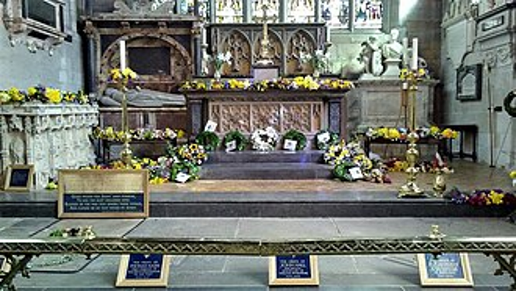
“Good friend for Jesus sake forbeare, to dig the dust enclosed heare.”— Shakespeare’s epitaph, Holy Trinity Church, Stratford; believed to be his own words
He died on April 23rd, 1616 — quite possibly his fifty-second birthday. Even in death, he was difficult to pin down. The epitaph on his grave is not a tribute to his genius. It is a warning to anyone who might disturb his remains. Right until the end, he resisted being fully known.
The man who slipped through history
He is everywhere and almost nowhere. The work fills libraries; the man is barely a shadow. He slips through history like a figure in one of his own comedies — disguised, elusive, constantly almost-revealed, never quite caught.
What we are left with is the plays themselves: thirty-seven worlds, each one containing multitudes, none of them exhausted by four centuries of reading. That may be the most Shakespearean thing of all — to be present in the work so completely that the author himself becomes unnecessary. The stage remains. The words remain. The man is gone.


Comments
Post a Comment