Unknown Facts About Shakespeare
The man who invented “eyeball,” survived plagues, cursed his own grave, and may have named his greatest tragedy after his dead son
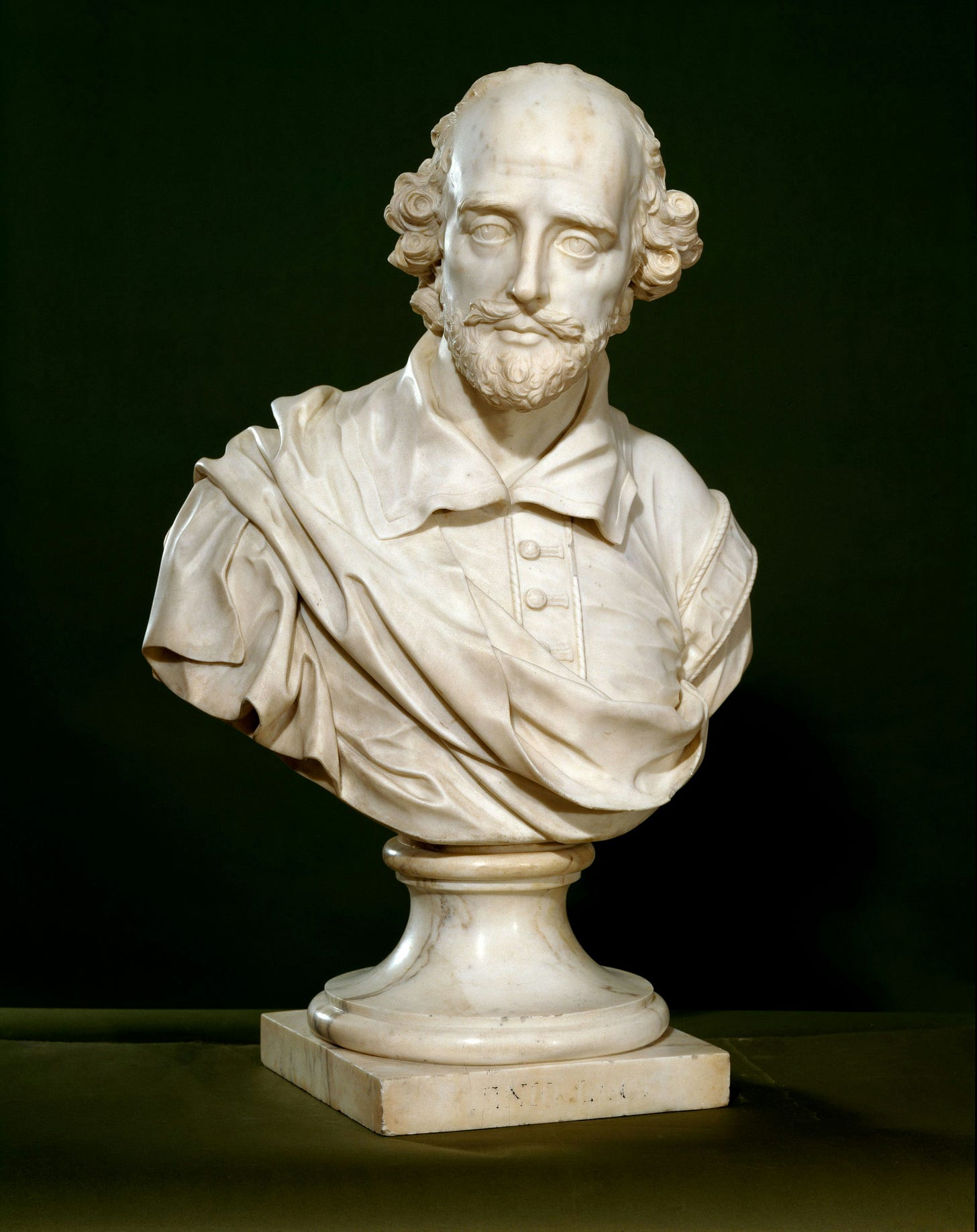 |
William Shakespeare was an actor, poet, and playwright who wrote roughly 37 plays and 154 sonnets. Despite his colossal literary footprint, enormous chunks of his life remain completely blank — and the parts we do know are far stranger than anything on the school syllabus.
1. He Invented Thousands of Words You Use Every Day
Shakespeare didn’t just write in the English language, he helped shape it. He is credited with introducing or popularizing somewhere between 1,700 and 3,000 words and expressions in English by converting nouns into verbs, combining words, borrowing from Latin, or creatively adapting existing language. In some cases he may have invented them; in others, he is simply the earliest surviving writer known to have used them. Words like “eyeball,” “bedroom,” “swagger,” “lackluster,” “addiction,” “lonely,” and even the name “Jessica” (from The Merchant of Venice) all trace back to his works. He also gave us common phrases like “break the ice,” “wear your heart on your sleeve,” and “it’s Greek to me” , expressions so embedded in everyday speech that most people have no idea they’re quoting a 16th-century playwright.
2. Seven Years of His Life Are Completely Unaccounted For
In 1585, Shakespeare’s twins — Hamnet and Judith — were baptized in Stratford-upon-Avon. Then he simply vanishes from the historical record. For a full seven years, between 1585 and 1592, there is no documented trace of where he was, what he was doing, or how he survived. When he finally resurfaces, he’s already an established actor and playwright in London. Historians call this gap “the Lost Years,” and the theories trying to fill it range from plausible to outright thrilling: he may have been a traveling actor, a country schoolteacher, a soldier in the Low Countries — or, according to one fringe but persistent theory, a spy for the Crown. Nobody knows. For the man the world considers its greatest writer, that is a stunning absence of paper trail.
3. He Survived Multiple Outbreaks of Bubonic Plague
Shakespeare was born in 1564, the same year a plague outbreak in Stratford-upon-Avon killed approximately one fifth of the town’s population. He survived that as an infant, and then went on to live through several more major plague outbreaks across his lifetime. The plague was not a distant headline for Shakespeare; it was a recurring fact of life that shut down London theatres for months at a time. When the playhouses closed, Shakespeare turned to writing, and historians believe the forced shutdowns of 1592–1594 in particular pushed him toward his narrative poems Venus and Adonis and The Rape of Lucrece, and likely contributed to the composition of the sonnets. The city he worked in regularly smelled of death, and he kept writing anyway.
4. He Put a Curse on His Own Grave
Shakespeare is buried beneath the chancel floor of Holy Trinity Church in Stratford-upon-Avon. He was well aware that it was common practice at the time for gravediggers to dig up old bones and move them to the charnel house to make room for new burials, and he apparently wanted no part of that. So he composed his own epitaph, explicitly threatening anyone who disturbed his remains:
“Good friend for Jesus’ sake forbear,
To dig the dust enclosed here.
Blessed be the man that spares these stones,
And cursed be he that moves my bones.”
It worked. His grave has never been officially excavated, though in 2016, ground-penetrating radar scans suggested that Shakespeare’s grave may have been disturbed at some point in the past, fueling speculation that his skull was removed. Whether the curse held is, strictly speaking, still an open question.
5. He Never Spelled His Own Name “Shakespeare”
In the six confirmed surviving examples of Shakespeare’s handwriting — all signatures on legal documents — he never once spelled his name the way the world now spells it. The signatures include variations like “Willm Shakspere,” “William Shakspeare,” and “Wm Shakspe.” In total, historians have identified more than 80 different recorded spellings of his name across documents of the era, used by himself and by others writing about him. The standardized spelling “Shakespeare” only became fixed after his death, largely through the 1623 First Folio. For a man whose name is arguably the most famous in literary history, he was remarkably casual about what it actually was.
6. His Son Was Named Hamnet — and Died at 11, Just Before Hamlet Was Written
Shakespeare and Anne Hathaway had three children. Their only son was named Hamnet — not a typo, and not a coincidence. In August 1596, Hamnet died at just eleven years old, cause unknown, and was buried in the churchyard at Holy Trinity Church in Stratford. Shakespeare may not have even been present; news would have taken at least two days to reach him in London, and his acting company was potentially on tour in Kent that summer.
Four or five years later — between 1599 and 1601 — Shakespeare wrote Hamlet.
The names Hamnet and Hamlet were considered interchangeable variants in Elizabethan England. Scholars have argued for centuries about whether the play was directly inspired by the death of his son, and the honest answer is: we don’t know. Shakespeare left no letters, no diary, no direct statement on the matter. What we do know is that in King John, written shortly after Hamnet’s death, Shakespeare wrote lines that many consider his most personal: “Grief fills the room up of my absent child / Lies in his bed, walks up and down with me.” Make of that what you will.
7. He Left His Wife His Second-Best Bed
Shakespeare’s will, dated March 25, 1616, distributes his estate in careful detail — property to his daughters, money to friends, rings to old colleagues. To his wife Anne, who had been married to him for 34 years, he left a single item written as an interlineation (an afterthought squeezed between the lines): “my second-best bed with the furniture.”
That is the only mention of her in the document.
Historians have never settled on what this means. The generous reading: the “best bed” in an Elizabethan household was typically kept in the guest room, while the second-best was the marital bed — so leaving it to Anne was a sentimental gesture. The less generous reading: it was a pointed snub, made all the more deliberate by the fact that it appears to have been added as an afterthought after the will was already drafted. They had spent most of their marriage living apart — he in London, she in Stratford. As for what Anne thought of the bequest, history is completely silent.
8. There Was No Copyright — So Rival Companies Stole His Scripts
In Elizabethan England, playwrights had no legal ownership over their plays once sold to a theatre company. Scripts were treated as trade secrets rather than published works, because the moment a competitor got hold of one, they could simply stage it themselves. To guard against this, actors in Shakespeare’s company — the Lord Chamberlain’s Men — were often given only their own lines and cues, not the full script. The practice of reconstructing scripts from memory was common; scholars believe several of the early “bad quartos” of Shakespeare’s plays (unauthorized printed versions with garbled text) were assembled by audience members or rival actors who attended performances and transcribed what they could recall. Shakespeare himself published almost none of his plays during his lifetime. The 18 plays that would otherwise have been lost were only preserved because two of his fellow actors — John Heminges and Henry Condell — compiled the First Folio seven years after his death.
9. He Wrote One of the Earliest “Your Mom” Jokes in English Literature
Modern humor, it turns out, is not very modern. In his 1594 play Titus Andronicus, one of his earliest and most violent works, Shakespeare included what many scholars and readers consider one of the earliest examples of a joke that modern audiences would recognize as a “your mom” joke. When the villainous character Aaron is confronted by Chiron, he responds:
“Villain, I have done thy mother.”
It is blunt, crude, and exactly what it sounds like. The joke is more than four centuries old, which means that if you have ever said “your mom” to win an argument, you are participating in a tradition that stretches back to the Elizabethan stage.
10. Because of Shakespeare, 200 Million Invasive Birds Now Overrun North America
This one reads like fiction. In 1890, a wealthy New York pharmaceutical manufacturer named Eugene Schieffelin walked into Central Park on a cold, sleeting March morning and released 60 European starlings into the American sky. He did the same with another 40 the following year.
According to a widely repeated story, Schieffelin wanted to introduce every bird mentioned in Shakespeare’s works to North America, though historians debate whether this was actually his motivation. Starlings appear in Henry IV, Part 1, where Hotspur fantasizes about training one to drive King Henry mad by repeatedly saying the name “Mortimer.”
The starlings survived. And thrived. And spread.
Today there are an estimated 200 million European starlings across North America, making them one of the continent’s most successful invasive species. They displace native birds, damage crops, and cause significant agricultural losses each year. Officials have tried everything from fake predators to recorded distress calls to control their numbers, with limited success.
One small release in Central Park ultimately helped create one of North America’s most widespread invasive bird populations, whether Shakespeare was truly the inspiration or not.
11. His Most Controversial Play Is Still Being Debated Today
More than 400 years after his death, scholars still argue about Shakespeare’s most controversial work: The Merchant of Venice.
At the center of the debate is Shylock, a Jewish moneylender who has been interpreted both as a harmful stereotype and as one of Shakespeare’s most sympathetic and complex characters. Some critics argue the play reflects the antisemitic attitudes of Elizabethan England, while others believe Shakespeare used Shylock to expose prejudice and hypocrisy.
The fact that audiences still cannot agree on how to interpret the play is part of what makes it so enduring. Few works from the 1590s continue to generate such intense debate about religion, discrimination, justice, and morality.
Note: The Shakespeare-motivation behind Schieffelin’s starling release is widely reported but not definitively confirmed by primary sources — the claim first appeared in print 41 years after Schieffelin’s death. The starling release itself, and its ecological consequences, are thoroughly documented.


Comments
Post a Comment