If Taylor Swift Albums Were Classic Novels
If Taylor Swift Albums Were Classic Novels
A literary companion to the Eras Tour — no ticket required
Literature · Music · Cultural criticism
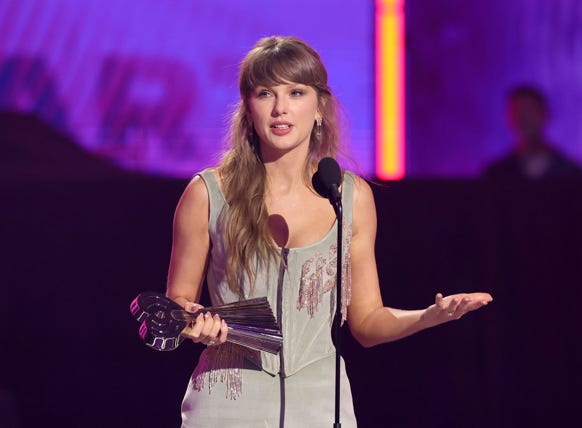
Every great author has a body of work that, read together, tells the story of a life. Taylor Swift is no different. Across twelve studio albums, she has written heartbreak and hope, reinvention and reckoning — the same obsessions that have animated literature for centuries. And like any serious author, she has now returned to her earliest chapters to set the record straight. Here, then, is the syllabus no English professor has assigned. Yet.
Taylor Swift - Debut (2006) 🌻🎸📝
Little Women
Louisa May Alcott · 1868
A teenage girl in a small town picks up a guitar and starts writing about boys, her feelings, and the wide world she can only see from her bedroom window. Sound familiar? Taylor’s debut is pure Jo March energy — ambitious, earnest, slightly starry-eyed, and absolutely certain that what she’s feeling matters enough to put on paper. Both works are deceptively simple on the surface and devastating in retrospect. You read them and think: she always knew exactly who she was.
“I wanted it to be perfect, so I did it myself.” — Jo March, essentially, and also Taylor Swift at sixteen.
Fearless (2008) 🌧️💛👢
Pride and Prejudice
Jane Austen · 1813
Pure romantic idealism wrapped in sharpest wit. Fearless is the album where Taylor stands in the rain waiting for a boy who may not deserve her — and she knows it, a little, but falls anyway. Elizabeth Bennet does the same thing, twice, with worse weather and a better vocabulary. Both Austen and Swift understand that falling in love is an act of profound optimism; that choosing to believe in someone is its own kind of courage. You Belong With Me is essentially 'It is a truth universally acknowledged,' set to banjo.
“She is tolerable, I suppose, but not handsome enough to tempt me.” Every boy Taylor Swift ever wrote a song about, basically.
Speak Now (2010) 💜⛈️📜
Jane Eyre
Charlotte Brontë · 1847
The album Taylor wrote entirely alone — no co-writers, no committee — and it shows in the best way. Like Jane Eyre, Speak Now burns with a fierce, private moral clarity. The protagonist will not be diminished. She will speak, even when the room tells her to sit down. Enchanted has all the gothic romantic yearning of Thornfield Hall; Mean is Jane telling Mr. Brocklehurst exactly what she thinks of him. Both women have more inner life than anyone around them expects, and both are entirely willing to walk out into the storm alone if that’s what it takes.
“I am no bird; and no net ensnares me.” Jane Eyre. Also: the entire premise of Speak Now.
Red (2012) 🧣🍁❤️
Anna Karenina
Leo Tolstoy · 1878
The sprawling, impractical, occasionally transcendent masterpiece. Red is Taylor’s longest album — and, like Tolstoy’s longest novel, it earns every page. All Too Well (Ten Minute Version) is a scarf that becomes a war crime, a red maple leaf, an elegy for a self that got left behind at someone’s father’s house. Anna Karenina is also about a woman consumed by a love that society labels inconvenient and art labels devastating. Both works insist that the feelings were real, even when the relationship wasn’t worthy of them. Loving and being destroyed by the same thing. Classic Tolstoy. Classic Taylor.
“Happy families are all alike; every unhappy family is unhappy in its own way.” Every unhappy relationship, too, Taylor would like to add — in ten minutes of meticulous detail.
1989 (2014) 🗽✨🥂
The Great Gatsby
F. Scott Fitzgerald · 1925
New York City. Parties where everyone is watching everyone else. A persona so polished it starts to feel like armour. 1989 and The Great Gatsby share the same electric loneliness — the feeling of being surrounded by glittering people and still eating cereal alone at midnight. Taylor’s reinvention into a pop icon mirrors Gatsby’s self-invention: the name changed, the aesthetic total, the ambition enormous. And underneath it all, both works ask the same quiet question: what if the life you built for yourself still doesn’t feel like yours?
“So we beat on, boats against the current.” Welcome to New York. Shake it off. The green light is across the water. Good luck.
Reputation (2017) 🐍🖤⚡
Wuthering Heights
Emily Brontë · 1847
Dark. Furious. Absolutely gothic. Reputation arrived after Taylor had been publicly dismantled and decided to dismantle the dismantlers right back. Wuthering Heights is also a story about what happens when someone you’ve wronged stops being soft about it. Heathcliff and the Reputation-era Taylor Swift share a worldview: the world has been cruel, and now the world will watch. Look What You Made Me Do is Heathcliff returning to Wuthering Heights with a waistcoat and a vendetta. I Did Something Bad is the novel's atmosphere distilled into three and a half minutes: fury, desire, self-destruction, and the conviction that if the world insists on making you a villain, you might as well become a memorable one. The love story, when it finally arrives, is all the more tender for the surrounding chaos.
“I am Heathcliff.” — Catherine Earnshaw. “I’m sorry, the old Taylor can’t come to the phone right now.” — Same energy, different century.
Lover (2019) 🩷🌈💌
A Midsummer Night’s Dream
William Shakespeare · 1600
Pastel, playful, occasionally chaotic, and completely unapologetic about being happy. Lover is the album where Taylor decided joy was allowed — and Shakespeare’s most beloved comedy is the text that matches that frequency exactly. It’s midsummer. Everyone’s in love with the wrong person or the right person or a man with a donkey’s head. London Boy is the mechanicals putting on a play. The Archer is the quiet moment in the forest when the enchantment lifts and you see yourself clearly. You Need To Calm Down is Titania telling Oberon, in the politest terms, to sit down.
“The course of true love never did run smooth.” — Lysander, A Midsummer Night’s Dream. Taylor would like that engraved somewhere.
Folklore (2020) 🌲🪞🧥
To the Lighthouse
Virginia Woolf · 1927
One of the most literary albums of Taylor’s catalogue pairs with the most literary novel in the English language — naturally. Both Folklore and To the Lighthouse are preoccupied with time, memory, and the stories we tell about people we may never fully know. Seven is a Woolfian stream of consciousness. The 1 is an elegy for versions of yourself that no longer exist. August, Betty, and James form a triptych that Woolf would recognise immediately: the same event, three interiorities, none of them complete. Isolation made both works possible. Both are better for it.
“Examine for a moment an ordinary mind on an ordinary day.” Woolf. Also: a pandemic, a cabin, a cardigan, a mirror.
Evermore (2020) 🍂🕯️🏚️
Middlemarch
George Eliot · 1872
Where Folklore is interior and impressionistic, Evermore widens the lens to an entire community — marriages falling apart, people choosing wrong, choices made in youth haunting people into middle age. This is George Eliot territory: the tragedy not of grand moments but of accumulated decisions, of lives that narrow slowly. Champagne Problems is Dorothea Brooke’s entire arc in four minutes. No Body No Crime is a sensation novel hidden inside Middlemarch’s pages. Both works are kinder to their characters than those characters are to themselves.
“The growing good of the world is partly dependent on unhistoric acts.” And on saying no. And on knowing when to leave the wedding.
Midnights (2022) 🌙🕰️💙
The Bell Jar
Sylvia Plath · 1963
3am thoughts. Self-mythology. The gap between the person the world sees and the person who lies awake cataloguing their own failures. Midnights is Taylor’s most introspective album — a record made from insomnia and self-interrogation, and Plath’s only novel is the classic text of that specific experience. Anti-Hero (”It’s me, hi, I’m the problem, it’s me”) is Esther Greenwood looking at herself in the asylum mirror. Lavender Haze is the fig tree: all the lives you could live and the paralysis of choosing. Both Plath and Taylor are accused of being too much. Both made that accusation into art.
“I saw my life branching out before me like the green fig tree in the story.” And I stood there, and I wrote a thirteen-track album about it.
The Tortured Poets Department (2024) 🖋️🤍📖
Madame Bovary
Gustave Flaubert · 1857
Both works are about the unbearable distance between the love you imagined and the love you received. Emma Bovary reads too many romance novels and expects life to perform accordingly; the narrator of TTPD builds a cathedral around someone who turns out to be a convenience store. Flaubert put himself in Emma’s shoes — “Madame Bovary, c’est moi” — and Taylor does the same with her poets and her tortured narrators. Both texts are also about the peculiar hell of being intelligent enough to see your own delusion clearly and being unable to stop anyway. A very specific, very human affliction. Flaubert would have liked the anthologies.
“She wanted simultaneously to die and to live in Paris.” — Emma Bovary. “I’m so in love that I might stop breathing.” Same difference, different century, same mistake.
The Life of a Showgirl (2025) 🎭✨🥂
Breakfast at Tiffany’s
Truman Capote · 1958
There is a particular kind of woman at the centre of both works: dazzling in public, unknowable in private, performing vivacity so seamlessly that the audience forgets she had to learn it. Holly Golightly moves through New York like she owns it while quietly eating crackers alone in her apartment; Taylor wrote this album in hotel rooms across Europe, between tour stops, flying back to Stockholm in secret to lay down tracks before the next show. The Life of a Showgirl is an album about the exuberant, electric life lived just off-stage — and Capote’s novella is the original backstage pass.
The Fate of Ophelia is Holly’s monologue about the “mean reds.” Elizabeth Taylor is every Capote sentence that sounds like a compliment until you read it twice. The title track — a country-pop ballad featuring Sabrina Carpenter — is the novel’s closing image: a woman who belongs nowhere and everywhere, glamorous and untethered, standing in the rain and calling it sequins. Both Capote and Taylor understand that the showgirl’s most vulnerable moment is the one she performs most beautifully.
“You know what’s wrong with you, Miss Whoever-You-Are? You’re chicken. You’ve got no guts.” — Holly Golightly. Taylor Swift, recording albums between tour dates, has the guts.
A note on Taylor’s Version
Between 2021 and 2023, Taylor re-recorded four of her first six albums — Fearless, Speak Now, Red, and 1989 — reclaiming ownership of her masters after they were sold without her consent. It is one of the most unprecedented acts in music history, and it has a clear literary precedent.
When a publisher owns the plates, they control the text. Charles Dickens rewrote the ending of Great Expectations under editorial pressure; he spent years lamenting it. Mary Shelley’s Frankenstein was published anonymously in 1818 because her name on the cover would have changed how the world received it. Zora Neale Hurston’s Their Eyes Were Watching God went out of print for decades — not because the work diminished, but because those who controlled the distribution decided it should.
The Taylor’s Version project is what happens when the author gets the plates back. Each re-recording arrives not just with restored masters, but with vault tracks — the deleted chapters, the scenes that didn’t make the final cut, the words that existed but were never published. In literary terms: the definitive edition. The one the author actually intended. The one that, from now on, belongs to her.
Acknowledgement: This essay is a work of literary criticism and cultural commentary. All song titles, album titles, lyrics, and literary works referenced remain the property of their respective authors, artists, publishers, and rights holders.
All albums listed in original release order. Taylor’s Version editions are, of course, the canonical texts — just as any author’s revised edition supersedes the first.
Follow me on Blogger:
literarydeepdives.blogspot.com
Follow me on Medium:
https://medium.com/@sugashnandita?source=post_page---byline--29340a7f72a0
Follow me on Substack:


Comments
Post a Comment