The World Was Built for Men — And the Data Proves It: A Review of Invisible Women
How one book dismantled everything I thought I knew about “neutral” design
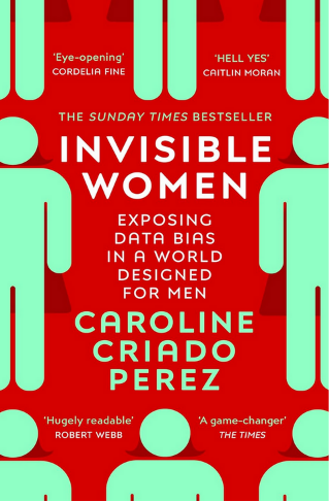 |
There’s a particular kind of anger that builds slowly. Not the hot, immediate kind — but the cold, creeping kind that arrives when you realise the world you’ve been navigating your entire life was never actually designed with you in mind. Caroline Criado Perez’s Invisible Women: Exposing the Data Bias in a World Designed for Men (2019) is the book that delivers that anger — methodically, devastatingly, and with 650-odd footnotes to back it up.
This is not a polemic. It is a forensic investigation. And it is one of the most important books of the past decade.
What the Book Is Actually About
The title might suggest a book about women being overlooked in history — and while that’s partly true, Invisible Women is really about something more specific and more alarming: the gender data gap.
Criado Perez’s central argument is deceptively simple. For centuries, the default human being in research, medicine, product design, urban planning, economics, and public policy has been a man — usually a white, Western man of average male size and physiology. Women have been treated as a “niche” variation of this standard, their bodies and behaviours unstudied, their needs unmeasured, their voices absent from the data that shapes the world.
The consequences, as she shows across 300+ pages, range from mildly infuriating to genuinely deadly.
Chapter by Chapter: Where the Gaps Show Up
Daily Life — The Invisible Inconveniences
Criado Perez opens with the mundane and the familiar: why are women always cold in offices? Why do women queue longer at public toilets? Why do women find it harder to grip most tools, smartphones, and car steering wheels?
The answer to all of these is the same: these things were designed around male bodies and male data. Office temperatures were standardised using a formula developed in the 1960s based on the metabolic rate of a 40-year-old, 70kg man. Most public restrooms allocate equal square footage to men and women — ignoring the fact that women take, on average, 2.3 times longer to use facilities. The “standard” smartphone size was set when the market was almost exclusively male. Women weren’t in the room when the defaults were decided. And so the defaults stuck.
This section of the book works brilliantly as an entry point because it begins with things you’ve probably already noticed and wondered about — and gives them a systemic explanation.
The Workplace — Unpaid, Uncounted, Unseen
One of the book’s most powerful threads is its examination of how economic measurement invisibilises women’s labour. GDP, that sacred metric of national progress, does not count unpaid care work — the cooking, cleaning, childcare, and eldercare that women disproportionately perform across the world.
Criado Perez draws on economic studies showing that if unpaid care work were counted, it would add tens of trillions of dollars to the global economy. Women are essentially running an enormous parallel economy — one that underpins every other economy — and it doesn’t show up in a single official statistic.
She also examines workplace design: from the “ideal worker” model (based on a man with a wife at home to handle everything else) to performance review language that rewards stereotypically masculine traits, to the infamous “gender-neutral” tax policies that in practice extract a higher effective rate from women because female spending patterns differ from male ones.
Urban Planning — Cities Built for Men
This chapter hit particularly hard. Cities — their streets, their transport networks, their lighting, their park designs — have overwhelmingly been planned by men, for the movement patterns of men.
Men’s travel tends to follow a simple hub-and-spoke pattern: home to work and back. Women’s travel is “trip-chaining” — school drop-off, grocery run, work, clinic, pick-up, home — a far more complex web of shorter journeys. Yet public transport has historically been optimised for the former, not the latter.
Snow-ploughing policy in one Swedish city provides a striking case study. The city had historically prioritised clearing highways and commuter routes first. A gender analysis revealed that women were far more likely to be injured in pedestrian accidents during winter — because the pavements, school routes, and local roads they used weren’t being cleared. When the city reversed the priority order, pedestrian injuries dropped significantly, male driver injuries stayed roughly the same, and the total cost was lower. A simple data lens changed lives.
Criado Perez also addresses the reality that women navigate public space differently because of safety concerns — shorter routes, busier streets, avoidance of underpasses. City design that ignores this doesn’t just inconvenience women; it constrains their freedom.
Medicine — When the Default Patient Is Male
This is where the book becomes frightening.
For decades, medical research excluded women from clinical trials — partly out of a misguided desire to protect women of childbearing age from experimental drugs, partly because female hormonal cycles were seen as a complicating variable. The result is a medical system with vast gaps in its knowledge of how diseases and drugs work in female bodies.
Heart attacks present differently in women than in men. Women are more likely to experience nausea, jaw pain, and fatigue than the “classic” crushing chest pain we associate with cardiac events. Because the classic presentation is based on male patients, women are significantly more likely to be misdiagnosed, sent home, and to die of a heart attack that was missed.
Drug dosages present another crisis. Because most drugs were trialled predominantly on men, standard doses are often too high for women — who metabolise many substances differently. The sleeping pill Ambien is Criado Perez’s most cited example: the FDA eventually halved the recommended dose for women, a decade after the drug had been on the market, after data finally emerged showing women were waking up impaired and causing car accidents at a far higher rate than men.
The chapter on medicine is a genuine gut-punch. This isn’t historical injustice — it is ongoing and it is costing lives.
Artificial Intelligence and Technology — Biased by Design
As the book moves into more contemporary territory, Criado Perez examines how the gender data gap is being baked into the algorithms and AI systems that increasingly govern our lives.
Facial recognition software trained predominantly on male faces performs significantly worse on female faces, and worse again on darker-skinned faces. Translation algorithms default to male pronouns when gender is ambiguous. Voice recognition systems were found to have substantially higher error rates for female voices. The reason, in each case, is the same: the training data was male-skewed, because the people building these systems — predominantly men — used themselves and their networks as the reference point.
As AI becomes embedded in hiring, healthcare, criminal justice, and financial services, these biases don’t just inconvenience — they systematically disadvantage.
Disaster and Conflict — The Ultimate Invisible Women
The final sections of the book examine how the data gap plays out at its most extreme: in natural disasters and conflict zones.
Women die at higher rates in natural disasters — not because of any biological vulnerability, but because of social ones. They may be less likely to be able to swim. They may be caring for children or elderly relatives when evacuation becomes necessary. Emergency shelters often lack safe sanitation for women. Disaster response planning built on male-default assumptions fails women at the moment of maximum vulnerability.
In conflict zones and refugee situations, the pattern repeats: women are underrepresented in peace negotiations, their specific needs (reproductive health, safety from gender-based violence, childcare) are routinely deprioritised in aid design, and the data to even identify and address these gaps is often never collected.
What Makes This Book Stand Out
Criado Perez is meticulous. Every claim is sourced. Every statistic is cited. For a book making such wide-ranging arguments, the rigour is remarkable — and essential. It makes the book essentially impossible to dismiss.
But Invisible Women is also, crucially, readable. Criado Perez is a journalist and activist, not an academic, and the prose reflects that. She moves briskly, uses vivid examples, and allows herself moments of dry wit and controlled fury. The book never becomes a slog.
The other thing that distinguishes it is its focus on systems, not villains. This is not a book about bad men. It is a book about how the absence of women’s data — often the product of thoughtlessness, assumption, and habit rather than active malice — creates structures that disadvantage women by default. That framing is more accurate, more useful, and ultimately more persuasive than a narrative of individual blame.
Criticisms and Caveats
No book of this scope is without its weaknesses.
Invisible Women focuses primarily on the experiences of women in wealthy, Western, relatively liberal societies. The lived realities of women in different cultural, economic, and political contexts occasionally feel underexplored, and a more global lens might have added further dimensions to the argument.
The book also, by design, operates on a gender binary. Criado Perez acknowledges this and explains her choice — the data she is analysing is itself collected in binary categories — but readers looking for a more expansive treatment of gender identity may find the framing limiting.
And while the solutions she proposes are sensible (disaggregate data by sex, include women in research and design, fund care work differently), some critics have argued they remain somewhat thin relative to the depth of the problem she diagnoses. The book is far stronger as a diagnosis than as a prescription.
These are minor reservations about an overwhelmingly important work.
Who Should Read This Book
Everyone. But specifically:
Anyone who designs things — products, buildings, software, policies, cities — and has never stopped to ask whose experience they’re optimising for.
Anyone in medicine, research, or public health who thinks “we just use the standard protocol.”
Anyone who has ever said “the data is neutral” — because the data, as this book shows, is never neutral. It reflects who collected it, who they thought mattered, and who was left out of the room.
And, of course, any woman who has ever felt that the world was subtly, persistently, structurally slightly wrong for her body and her life — and couldn’t quite put her finger on why. This book will give you the language, the evidence, and the framework.
Final Verdict
Invisible Women is one of those rare books that genuinely changes how you see the world. After reading it, you cannot unsee the male default. You notice it in the grip of your phone, in the temperature of the conference room, in the side effects on the medication packet, in the route the snowplough took, in the distance to the nearest well-lit bus stop.
That’s what great non-fiction does. It rewires perception permanently.
Caroline Criado Perez has written an urgent, rigorous, enraging, and essential book. Read it. Then look around. You’ll see the gaps everywhere.
Quick Reference
Title: Invisible Women: Exposing the Data Bias in a World Designed for Men
Author: Caroline Criado Perez
Published: 2019 (Chatto & Windus)
Genre: Non-fiction / Gender Studies / Data & Society
Rating: ★★★★★ (5/5)
— Review by Tiad. S
Credits, Disclosure & Affiliate Notice
This blog post is an original review written independently, intended for commentary, criticism, and educational purposes.
All references to Invisible Women (2019) are for the purpose of review and critical analysis only. The book is written by Caroline Criado Perez and published by Chatto & Windus (UK) and Abrams Press (US). All intellectual property rights to the original work belong to the author and publisher.
No portion of the original text of the book has been reproduced here. This review is based on the reviewer’s reading of the book and contains only original commentary, analysis, and opinion, consistent with principles of fair use and fair dealing applicable to literary criticism and review.
The book cover image used in this post is displayed solely for identification, commentary, and review purposes. All rights to the cover artwork remain with the respective rights holders.
Support the author: Purchase Invisible Women through your local bookstore, library, or a retailer of your choice. Caroline Criado Perez also writes a newsletter and is active on social media — her ongoing work is well worth following.
If this review has inspired you to read Invisible Women, you can purchase a copy through your local bookstore, library, or online retailer.
Buy the book here: https://amzn.to/4vE97Zk
This is an affiliate link. If you purchase the book through this link, I may earn a small commission at no additional cost to you. Thank you for supporting both the author and this blog.
Comments
Post a Comment